


Why Healthcare Must Shift from Reaction to Prediction
The Real Cost of Predict And Prevent Health Events
Every year, millions of seniors are hospitalized due to falls, fainting episodes, breathing irregularities, or sudden mobility decline. These incidents are often labeled as unavoidable consequences of aging, but in reality, many of them are not true “accidents.” They are the visible outcome of silent warning signs that have been building beneath the surface for days or even weeks.
Research in fall prevention and geriatric medicine consistently shows that changes in walking speed, nighttime behavior, sleep quality, and daily activity patterns often precede serious incidents. Seniors may begin taking shorter steps, resting more frequently, or avoiding certain areas of the home. Yet in most care models, these signals remain unnoticed until an emergency has already occurred. Traditional healthcare systems are built to respond quickly, but not to anticipate quietly. This reactive structure leaves a dangerous gap in protection at precisely the moment when early intervention would be most effective.
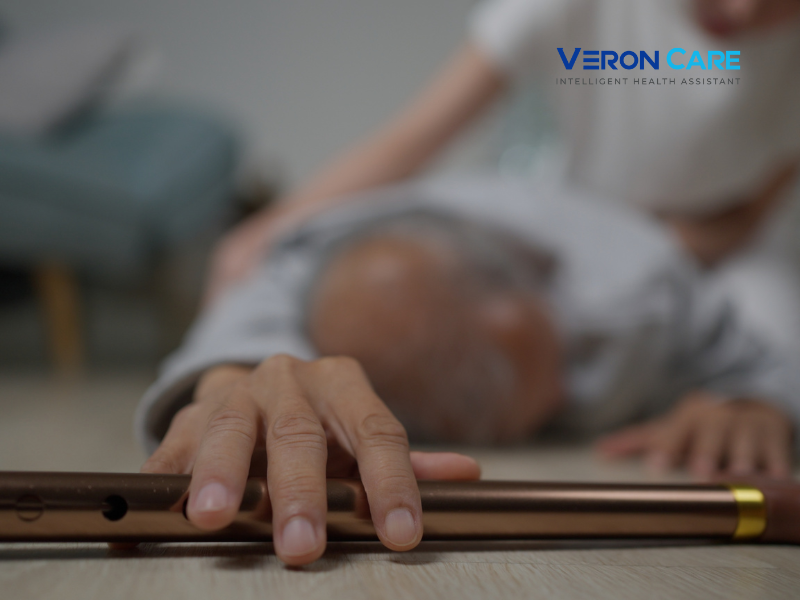
AI-powered monitoring can alert caregivers when a fall happens, even when seniors cannot call for help.
Why Traditional Monitoring Only Reacts to Crises
Most eldercare technologies available today are designed around a single moment: the emergency itself. Wearable panic buttons are useful only if the senior remembers to press them. Camera systems may capture an incident but do little to explain why it happened. Even advanced alert devices typically respond after the fall, not before.
This means seniors remain unprotected during the most critical phase: the gradual decline that leads to injury. By the time caregivers are notified, the damage has already been done. Recovery is slow, confidence is shaken, and the risk of repeat incidents increases dramatically.
What Are “Predict And Prevent Health Events”?
Common Elderly Emergencies That Can Be Predicted
Preventable health events include falls, fainting, respiratory distress, stroke-like inactivity, dehydration-related weakness, and prolonged immobility. These emergencies are rarely isolated events. Instead, they are part of a pattern that develops over time, driven by fatigue, medication side effects, muscle loss, dehydration, or chronic illness.
The Hidden Patterns Behind Falls and Health Decline
A fall almost never happens without warning. Before the incident, seniors often experience unsteady gait, difficulty rising from chairs, hesitation when turning, or subtle loss of coordination. These behaviors may not alarm family members during a short visit, but when observed continuously, they form a clear trajectory of increasing risk. AI systems trained to analyze long-term movement behavior can detect these patterns far earlier than human observation.
How Early Warning Health Alerts Actually Work
From Movement Data to Meaningful Risk Signals
Predict and prevent health relies on passive, continuous monitoring rather than isolated checks. Instead of asking “Did a fall happen?”, AI systems analyze how long a senior remains active, how often posture changes occur, how much time is spent resting, and whether daily routines are shifting.
Over time, this creates a personal behavioral baseline. When deviations appear such as reduced mobility, fragmented sleep, or prolonged bathroom stays the system recognizes these changes as early risk signals and generates an alert.
When an Alert Becomes Life-Saving
An early warning alert might notify caregivers that a senior has been unusually inactive for two days or has shown irregular nighttime behavior. This allows families to intervene with a phone call, home visit, hydration reminder, or medical checkup often preventing an emergency before it unfolds.
Fall Prediction Technology: Beyond Simple Fall Detection
Why Falls Rarely Happen Without Warning
Falls are rarely caused by a single factor. They are usually the result of cumulative risks such as medication reactions, fatigue, dehydration, illness, or declining muscle strength. Predictive AI models identify how these risks interact over time, revealing danger long before a fall becomes inevitable.
How AI Identifies Fall Risk Days in Advance
Fall prediction technology does not look for one dramatic signal. Instead, it combines dozens of micro-patterns such as slower walking speed, increased rest breaks, and nighttime wandering. When these patterns converge, caregivers receive alerts days ahead of potential danger.
Continuous Predictive Health Insights
Turning Daily Behavior Into Health Intelligence
Predictive systems transform everyday movement into long-term health intelligence. A decline in daily steps, longer bed-rest periods, or irregular sleep can all signal emerging issues. Over weeks, this information creates a dynamic health profile rather than a static snapshot.
Detecting Health Decline Through Subtle Change
Many chronic conditions develop gradually. Continuous predictive insights allow caregivers to see not just what happened today, but how today compares to last month: revealing slow deterioration that would otherwise remain hidden.
Proactive Elderly Care Solutions in the Home
From Emergency Response to Daily Risk Prevention
True proactive care means reducing the likelihood of emergencies, not simply responding to them. By identifying risk patterns early, families can adjust medication, encourage hydration, modify routines, or schedule medical checkups before a crisis unfolds.
Supporting Families and Caregivers With Confidence
Caregiving often involves uncertainty. Predictive insights replace guesswork with clarity, allowing families to act based on data rather than fear or intuition.
How Veron Care Enables Predict-and-Prevent Healthcare
Radar + AI for Continuous Risk Awareness
Veron Care combines radar-based sensing with artificial intelligence to detect movement, presence, breathing patterns, and posture changes. Unlike cameras or wearables, radar requires no user interaction and never collects visual data.
No Cameras, No Wearables. Just Smart Protection
Veron Care is designed to disappear into daily life while quietly protecting seniors. Its predictive engine turns continuous monitoring into actionable early warnings: allowing families and care providers to prevent harm before it happens.
Conclusion: The Future of Senior Care Is Proactive, Not Reactive
Predictive healthcare is not about replacing caregivers: it is about empowering them with insight. By shifting from emergency response to early intervention, we can transform eldercare from a cycle of crisis into a system of prevention. Ready to move from reacting to emergencies to preventing them? Discover how Veron Care’s predictive, camera-free technology helps families and care facilities stop health risks before they happen.